
The history of artificial lighting in Italian interiors before the 1950s is largely a history of decoration. Ceiling fixtures with glass shades, floor lamps with fabric diffusers, wall sconces in bronze or iron — these objects illuminated rooms, but they did not alter the spatial relationship between light and architecture. That relationship began to change in Milan in the years immediately following the Second World War, primarily through the work of one designer: Gino Sarfatti.
Gino Sarfatti and the founding of Arteluce
Sarfatti (1912–1985) was born in Venice to a prosperous family. He had enrolled in an aeronautical engineering programme in Genoa when the League of Nations imposed sanctions on Italy in 1935 in response to the Ethiopian campaign. His father's business collapsed. Sarfatti left his studies and moved to Milan, where he began designing lighting fixtures. In February 1939 he founded Arteluce — a compound of arte (art) and luce (light) — initially as a small manufacturing and retail operation.
His background in engineering rather than fine arts or architecture had a direct effect on how he approached lighting. Sarfatti was interested in the mechanics of light distribution — how a reflector's angle determined the cone of illumination, how the distance between a bulb and its shade changed the quality of the diffusion. His first designs were technically motivated: they solved specific problems of light placement that existing fixtures did not address.
The lamp as spatial proposition
By the early 1950s, Sarfatti had developed a design approach that was consistently structural rather than decorative. His Model 1063 floor lamp (1954) consists of a single adjustable arm on a heavy marble base, holding a small spot reflector. The arm is not concealed; it is the visual subject of the object. The lamp does not pretend to be a piece of furniture with a light attached; it is a mechanism for placing light at a precise angle in a room.
The 1063 won the Grand Prix at the Milan Triennale in 1954. That same year, two other Arteluce models — the 559 and the 1055 — received ADI Compasso d'Oro awards, the design prize established by La Rinascente to recognise industrial design of quality. Three major prizes in a single year constituted a clear statement about where Italian lighting design was positioned relative to its European counterparts.
The lamp should tell you exactly where the light is going and why. Everything else is furniture pretending to be technology.
Milan as a retail context: the Arteluce shop
In 1953 the designer Marco Zanuso — whose collaboration with Pirelli on latex foam seating had already established him as a technically literate architect — redesigned Arteluce's flagship shop on Corso Littorio (now Corso Matteotti). The redesign positioned Arteluce within Milan's design retail culture as a serious architectural presence, not merely a lighting supplier. A second shop, on Via della Spiga, was designed in 1962 by architect Vittoriano Viganò.
The Via della Spiga location placed Arteluce in a street that also contained showrooms for several furniture manufacturers, establishing a physical proximity between lighting design and the interior furnishing context it inhabited. A designer or architect specifying an interior in 1962 could, within a short walk, examine Arteluce lamps in relation to Cassina furniture and textiles from other Milanese producers.
Flos: a different manufacturing logic
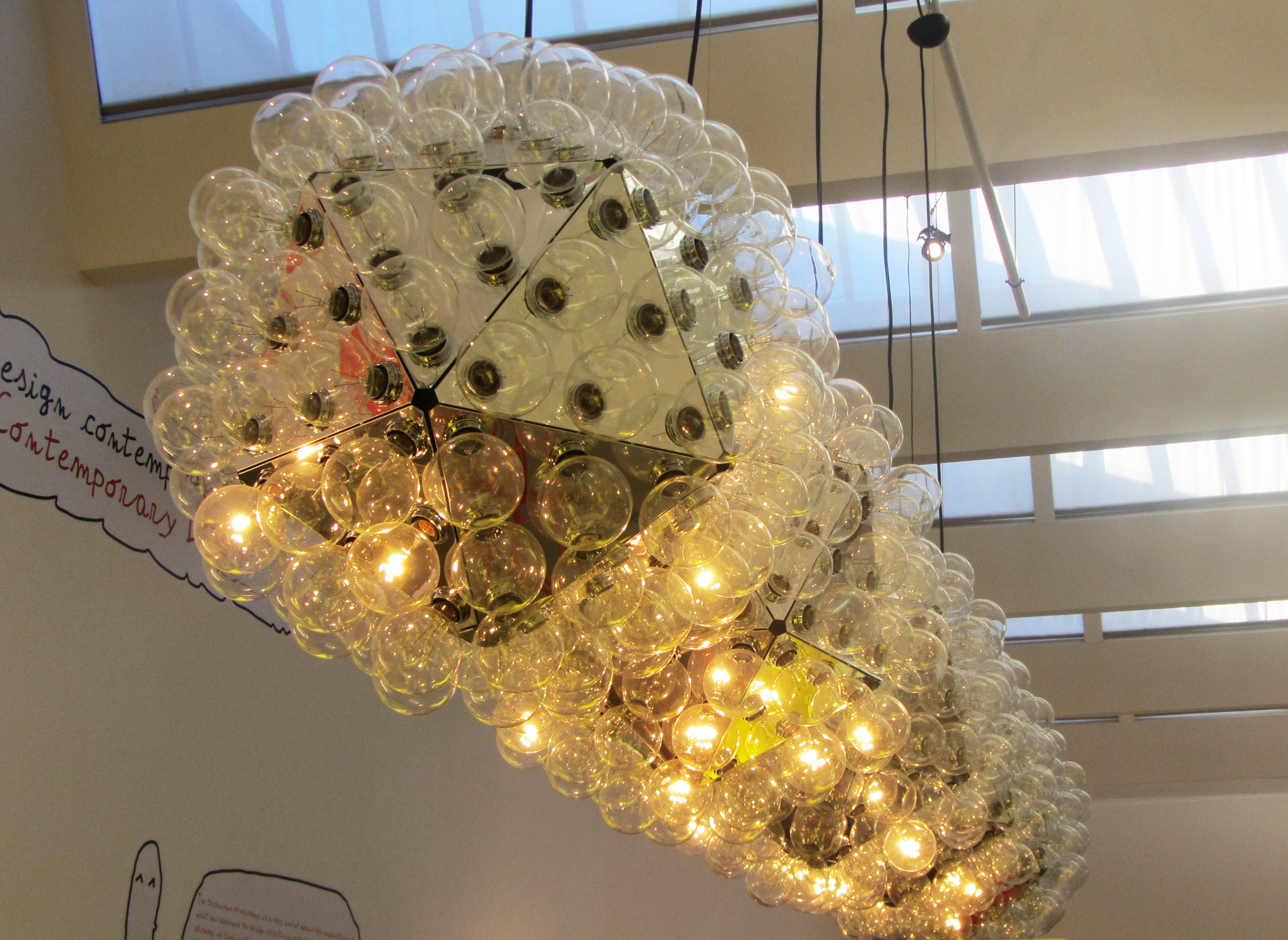
Flos was founded in Merano in 1962 by Dino Gavina and Cesare Cassina (the same Cassina who would later co-found B&B Italia). The company's technical distinguishing feature, in its early years, was the use of Cocoon — a thermoplastic resin developed for aeronautical use, sprayed over a wire armature to create diffusers of irregular organic form. The first Flos lamps, designed by Tobia Scarpa and Afra Scarpa, used this material to produce objects that had no precedent in existing lighting manufacture.
The Cocoon series established Flos as a company willing to develop manufacturing techniques specifically for a design application — the same logic that Cassina had applied to furniture production. Where Arteluce's strength was Sarfatti's individual design intelligence, Flos operated from the beginning as a manufacturer-designer partnership model, attracting multiple architects and designers to develop objects that its technical facilities could produce.
The Arco lamp and architectural light
Achille and Pier Giacomo Castiglioni's Arco lamp (1962), one of the first objects produced by Flos, demonstrated what the new Italian lighting approach could achieve. The lamp consists of a heavy Carrara marble base — heavy enough that it cannot be knocked over by accident — supporting a stainless steel arc that extends 2.5 metres horizontally before curving down to hold a small reflector. The arc allows the lamp to position direct light over a dining table without the need for ceiling attachment or surface mounting.
The design solved a specific problem: Italian apartments of the period often had ornate moulded ceilings that could not be drilled without damage, yet required directed task lighting over tables. The Arco's solution was purely structural — use the floor as the anchor point, use the arc to reach the table. The aesthetic character of the object follows from this structural logic rather than preceding it.
Arteluce and Flos: parallel positions
Arteluce and Flos occupied different positions in the 1960s Italian lighting landscape without being direct competitors in the conventional sense. Arteluce was identified with Sarfatti's individual design voice — the 400-odd objects he produced over his career are stylistically various but coherent in their structural approach. Flos developed a wider designer network: the Castiglioni brothers, Tobia and Afra Scarpa, and later Gae Aulenti, Vico Magistretti, and others produced objects for the company that reflected their individual practices.
During the 1960s, Arteluce collaborated with Franco Albini, Cini Boeri, Ico Parisi, and Massimo Vignelli — a group whose design approaches ranged from the rationalist rigour of Albini to the more exploratory formal work of Boeri. This diversity of collaboration reflected Sarfatti's willingness to extend the Arteluce design identity beyond his own formal preferences.
The 1973 acquisition and its implications
In late 1973 Sarfatti sold Arteluce to Flos and retired. The acquisition consolidated the two most significant Italian lighting companies of the postwar period under a single ownership, which had the practical consequence of giving Flos access to the entire Arteluce archive — including the production tooling and licensing rights for Sarfatti's catalogue. Some Arteluce models have subsequently been maintained in production; others have been discontinued.
The acquisition also marked a transition in Italian lighting design more broadly. By 1973, the material and formal experiments of the 1960s had been absorbed into a mainstream commercial catalogue. The structural rigour that characterised both Arteluce and early Flos was less consistently present in the wider Italian lighting market of the mid-1970s, where formal novelty had begun to substitute for technical investigation.
Sources and further reading
The primary source on Arteluce is the company's own archive, portions of which are documented at the Casati Gallery's Arteluce history. Gino Sarfatti's biography and design catalogue is documented at Casati Gallery. Flos maintains a historical account of its founding period and early catalogue. For broader context, Sparke's Italian Design: 1870 to the Present covers the relationship between lighting manufacture and the wider Italian design economy.
Last updated: May 3, 2026. External sources: Casati Gallery: Arteluce · Vintage Design Lighting: Sarfatti Story · Flos.